Why use it and how do you apply it?
As part of my brass prep, after FL sizing, I set neck interference with a mandrel. I dip case neck into graphite (has tiny shot in the jar as well); wipe outside, press in mandrel. Then use mop to get excess graphite out. Make bullet slide in easier too
I have used lockez and neo lube#2 and both work well. Both help with bullet seating.
Copy. Have you compared with to w/o graphite for ES or SD?
I use Neo-lube in case necks. I actually just ran a comparison check with once fired brass no neck lube vs Neo-lube. I shoot in long range matches where ES/SD are major factors, so looking for the smallest ES/SD as possible.
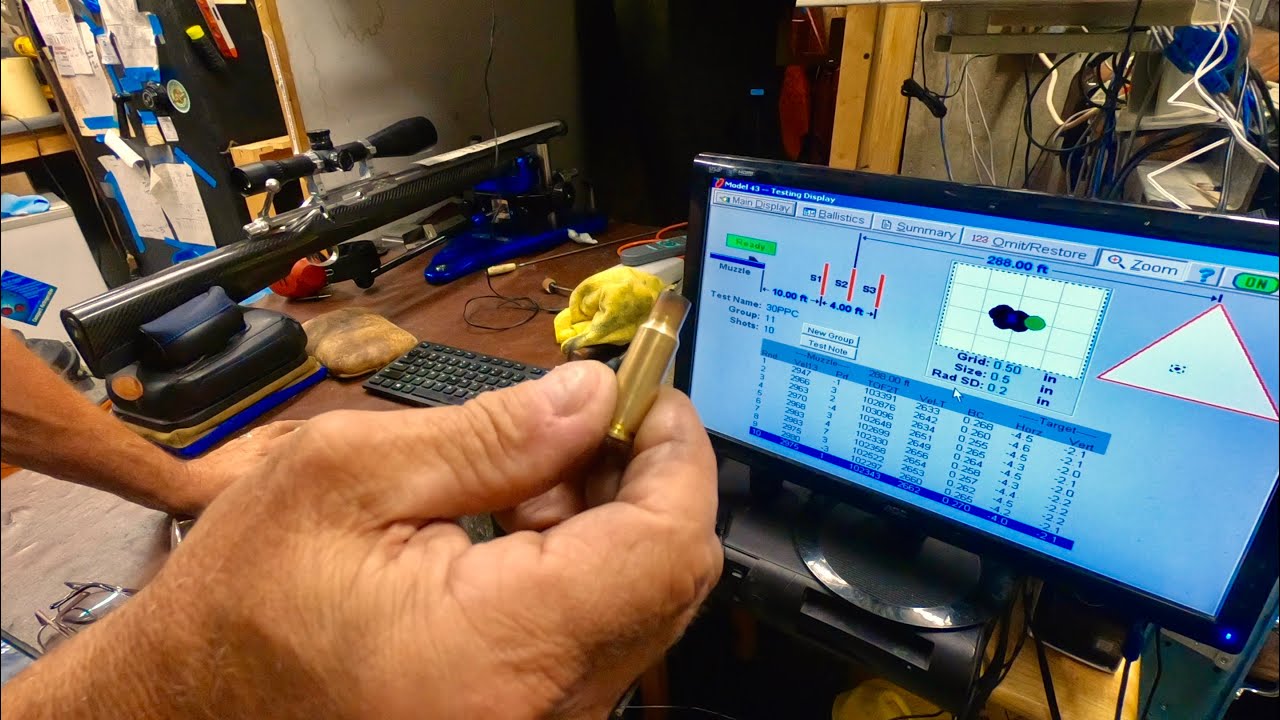
Results were not conclusive (small 5 shot groups). 300 WSM, 200.20X Berger bullet had the largest average velocity difference, but ES/SD very little difference (Neo-lube velocity 2944, ES 16.1, SD 6.2) - (no lube velocity 2963, ES 18.0, SD 7.4).
220 gr Berger Long Range - Neo-lube velocity avg 2859, no lube velocity avg 2860. Not much difference.
yes, before using the mandrel (only FL sizing / bushing), the ES / SD s were about 5-7 higher. Saw a vid by an ELR shooter that was adding the mandrel process with graphite dip so I tried it and did a bit better as noted so I guess the process was worth the effort. YMMV
Before using graphite , research what it can do to certain metals . Also it depends on why and how you are reloading . If you’re a Benchrest shooter and you are loading for a match where you will be shooting the next or that day and cleaning you rifle after very few shots it would be ok . If you are a hunter and you reloading for the season I would recommend Moly . Moly is a metal inhibiter . It lubricates and prevents the 2 different metals from bonding , Copper and Brass . This is important especially if the loads are going to be around for a while . When the metals start to bond pressure will be different and there for ES/SD are poor . World class Benchrest shooters also Moly . I don’t load and leave them sit on the shelf long . I use Moly , I use a mop to apply . I have my case totally ready to load with primer in and turn it upside down so when I moly it doesn’t trickle into the primer tap it once on the side of the bench its ready for powder then bullet . Some world class Shooters believe that the two metals start bonding right away . Thats why they moly . Some even Moly the bullet . Remember they look for .100 in there groups . I do use a dry graphite on my necks when sizing outside and in . I dip it into the beads neck first . I wipe it off and proceed . I’m no Scientist . I just do my research and only listen to world class Champions which I am neither BUT I have shot groups in the 0s and 1s and have some good ES/SD .
Thanks for the in-depth reply. It begs the question…why not just use moly coated bullets if they’re even still available? I’ll be shooting 1000 yd. prone again after a 20 year hiatus.
Eric Cortina - F class 1000 yards / Alex Wheeler - 1000 yard Bench Rest / Lou Murdica - Benchrest / Bryan Zolikov Benchrest . Here are some World Class , International Champions / Benchrest Hall of fame shooters that have great Youtube videos . Some use graphite some use moly . and as far as using moly bullets , I don’t know of anyone doing that any more? Maybe David Tubbs ? but you would get much better results with Berger bullets that have won many competitions and using some Moly on the inside of necks . Check these guys out , Don’t take my word for it . Good luck and keep Shooting .
1 Like
Hello Brooks.. The only time I use graphite inside necks is on “virgin / unfired” brass. EXAMPLE: I just got a new barrel about 5 months ago. It is chambered in 6.5 x 47 Lapua. It shoots the Berger 144 LRHybrid. I have a match coming up this weekend BUT I loaded back in November last year. I loaded them about 20thou long. Just this week I set them to their correct seating depth. I did NOT hear that “snap” I would have got had I not used graphite. SOOOO the questions then becomes “Why not just use graphite and seat them to the correct seating depth when you first loaded them?” ANSWER: Because I have had it BOTH ways>>> no need to seat long and I hear that “snap”. EITHER way, it is a good idea to use powdered graphite inside the necks on UNFIRED brass. After firing, a good “carboned-up” neck brush is all I use and never experience issues.
1 Like
Thank-you to all for your detailed responses. I’m most grateful. God’s blessings, Brooks
Use it to stop galling and I put it on a q-tip, dipping the q-tip into the plastic container and apply it to 3 case necks then re-dip the q-tip, turn case upside down and tap it on the bench to remove excess graphite.
I make long range precision rifles and have shot in competition myself for a long time. I tried graphite for a while once. I live by 3 simple rules:
- If it makes your 1000 yard groups smaller do it.
- If it doesn’t make your 1000 yard groups smaller, don’t do it unless it is fun.
- If it makes your 1000 yard groups larger, don’t do it.
Graphite was a 2 and it consistently made such a mess that I learned new cuss words. It wasn’t fun. I now use a light spray of One Shot. That dries instantly and doesn’t contaminate powder. Neck tension has not wrecked my groups as long as I turn necks diligently and use bushing dies with the right bushing.
1 Like
I do the same. Thank-you
I too use neo-lube2. I notice tha bullet seating is effortless like you would have very light neck tension.
I can’t prove nor care to test that it makes my groups smaller as I just started using it on my last 2 batches of reloads. Maybe down the road
I use it to prevent any metal to metal welding as I have rifles that might only get fired every 1 to 2 years.
Is that a sign that I have more than I need? Guess there is no such thing as having 2 many!
Where can someone get liquid Moly that can be painted inside the neck of casses
Moly I use is a dry powder I get across Amazon . I cut a hole big enough for my mop in the bottle , same size I would use in the barrel . I lay out paper towel hold the case so it’s pointed slightly down in one hand use the coated mop in the other . I mop it good , tap case so excess goes onto towel . Done .
Ok, I have been using a liquid moly that was made for coating bullet molds when casting, but the maker isn’t around anymore. CRC has it in a spray can but doesn’t sell it non aresol. I use a Q-tip to paint the inside of the neck, and it dries pretty fast. I haven found a source of it so when I run out, that’s
it.