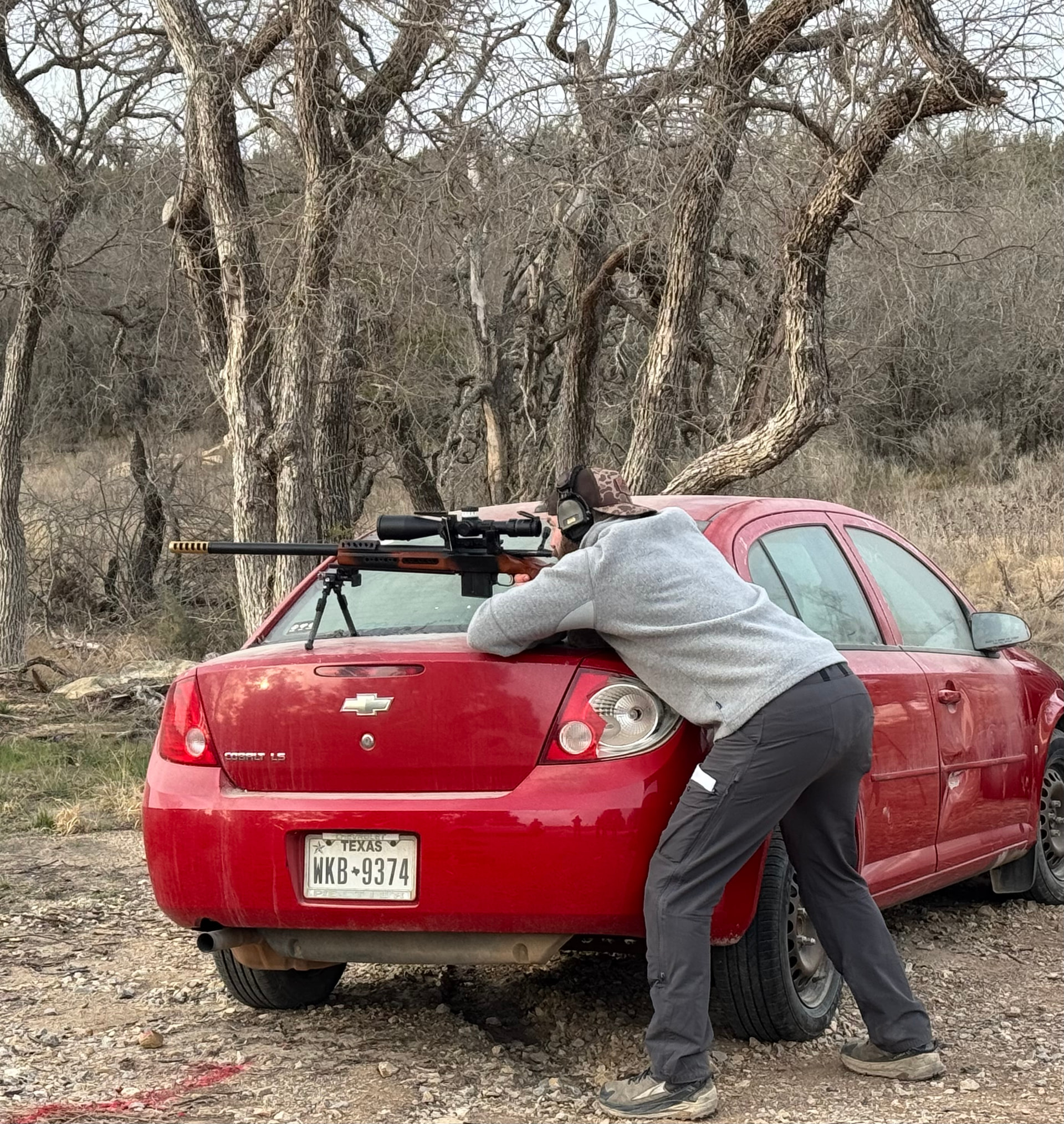
How many points of contact should you aim for, for effective shooting?
Typically 2 points of contact on the rifle itself (front and rear support), plus a strong body/base with as many additional points of contact as possible for overall stability.
In PRS (Precision Rifle Series) barricade shooting, “points of contact” generally refers to how the rifle is supported for stability, recoil management, and quick follow-ups. The goal is to minimize wobble while balancing speed and precision, especially on positional stages.
Rifle Support (Primary Focus)
• One point of contact (fastest but least stable): Rifle front (fore-end or bag) directly on the barricade/prop, with the shooter managing the rear via body/shoulder only. Good for closer, larger targets or when time is tight.
• Two points of contact (preferred for most situations): Front support on the barricade (usually padded with a bag or barricade stop for repeatability and to avoid hard contact) + rear support (e.g., rear bag attached to the rifle, tripod leg pinched against the stock, or strong body position). This is much steadier for longer-range or smaller targets.
Experts like Jeremy Tye emphasize building toward two rifle points of contact when possible, often combining a front barricade bag with a rear bag or tripod.
Body/Overall Stability
Shooters maximize additional points of contact with the ground, prop, or barricade for a solid base:
• Double kneeling: Both knees down for two solid ground contacts—often more stable than single knee or standing.
• Bone support and loading: Use elbows/arms on the barricade, support hand gripping/pushing the fore-end, shoulder into the stock, and lean/pressure into the prop (“loading” the rifle forward). Spread feet shoulder-width (or wider) in standing positions.
• More contacts = better: Some describe 3+ points (e.g., front rifle, rear, plus body/knees) or even 7 distinct body/rifle contacts in optimized setups. The principle is “the more points of contact, the better.”
Practical Tips for Barricades
• Pad the contact: Use a rear bag, Game Changer-style bag, or dedicated barricade stop on the fore-end to cushion and stabilize against the prop. Avoid direct metal-to-wood contact.
• Position choices: Lower is generally better (kneeling/sitting over standing). Adapt to the specific barricade (traditional stepped, natural like rocks/trees, or non-standard).
• Practice fundamentals: Consistent cheek weld, natural point of aim, and minimal muscle tension. Train transitions and different heights/angles, as PRS barricades vary.
It’s about what works best for stability vs. time on a given stage.